
How to Use Vrindavan Ki Raj (Braj Raj) — A Complete Guide
How to Use Vrindavan Ki Raj (Braj Raj) — Complete Guide | Keli Kunj Meta Description: Wondering how to use Vrindavan Ki Raj for tilak, puja, or daily practice? A simple, respectful guide to using this sacred soil the right way. Focus Keyphrase: how to use vrindavan ki raj
At Banke Bihari temple, early in the morning before the crowds arrive, you’ll sometimes see an old devotee crouched quietly near a corner of the parikrama marg, gently collecting a small pinch of dust into a folded cloth. He’s been doing this for decades, he once told me, ever since his guru explained to him that the ground of Vrindavan itself is not ordinary earth — it’s believed to be soaked in the footprints and the leelas of Radha and Krishna. “Ye mitti nahi hai,” he said, “ye toh Thakur Ji ke charno ki dhool hai.” This isn’t dust, it’s the dust of the Lord’s own feet.
That reverence is exactly why Vrindavan Ki Raj — also called Braj Raj — occupies such a special place for devotees, whether they live five minutes from the temple or on the other side of the world. But because it’s not something most people grew up using daily, a common question we get is simple: how is it actually meant to be used? Here’s a clear, respectful guide.
What Exactly Is Vrindavan Ki Raj?

जो रज शिव सनकादिक लोचत, सो रज शीश चढ़ाऊँ।
व्यास स्वामिनी की छवि निरखत, विमल विमल जस गाऊँ॥ किशोरी तेरे चरनन की रज पाऊँ। बैठी रहूं कुंजन के कोने, श्याम राधिका गाऊँ॥
पद का भावार्थ
- हे किशोरी (श्री राधा रानी)! मुझे बस आपके चरणों की धूल (रज) मिल जाए।
- मैं वृंदावन के किसी कुंज (बाग) के कोने में बैठकर सदा श्री श्याम और राधिका का नाम गाता रहूँ।
- जिस चरण-रज को पाने के लिए महादेव शिव और सनकादिक ऋषि भी तरसते हैं, उसी महाप्रसाद रूपी रज को मैं अपने सिर पर चढ़ाऊँ।
- व्यास जी कहते हैं कि मैं अपनी स्वामिनी श्री राधा जी के दर्शन करते हुए उनके निर्मल यश का गान करता रहूँ।
Vrindavan Ki Raj is sacred soil collected from holy sites across Vrindavan Dham — including places associated with Radha Kund, the parikrama marg, and other locations connected to Krishna’s leelas. In Vaishnav tradition, the very ground of Braj is considered divine, believed to carry the presence of Radha-Krishna’s pastimes even today. This is different from ordinary soil in both meaning and how devotees choose to use it.
It typically comes in two forms: a lighter, sandier soil and a darker mitti, sometimes labelled separately (for instance, “Radha Kund Ki Raj” for the darker variant). Both are used in largely the same ways, though some devotees have personal or lineage-based preferences for one over the other.
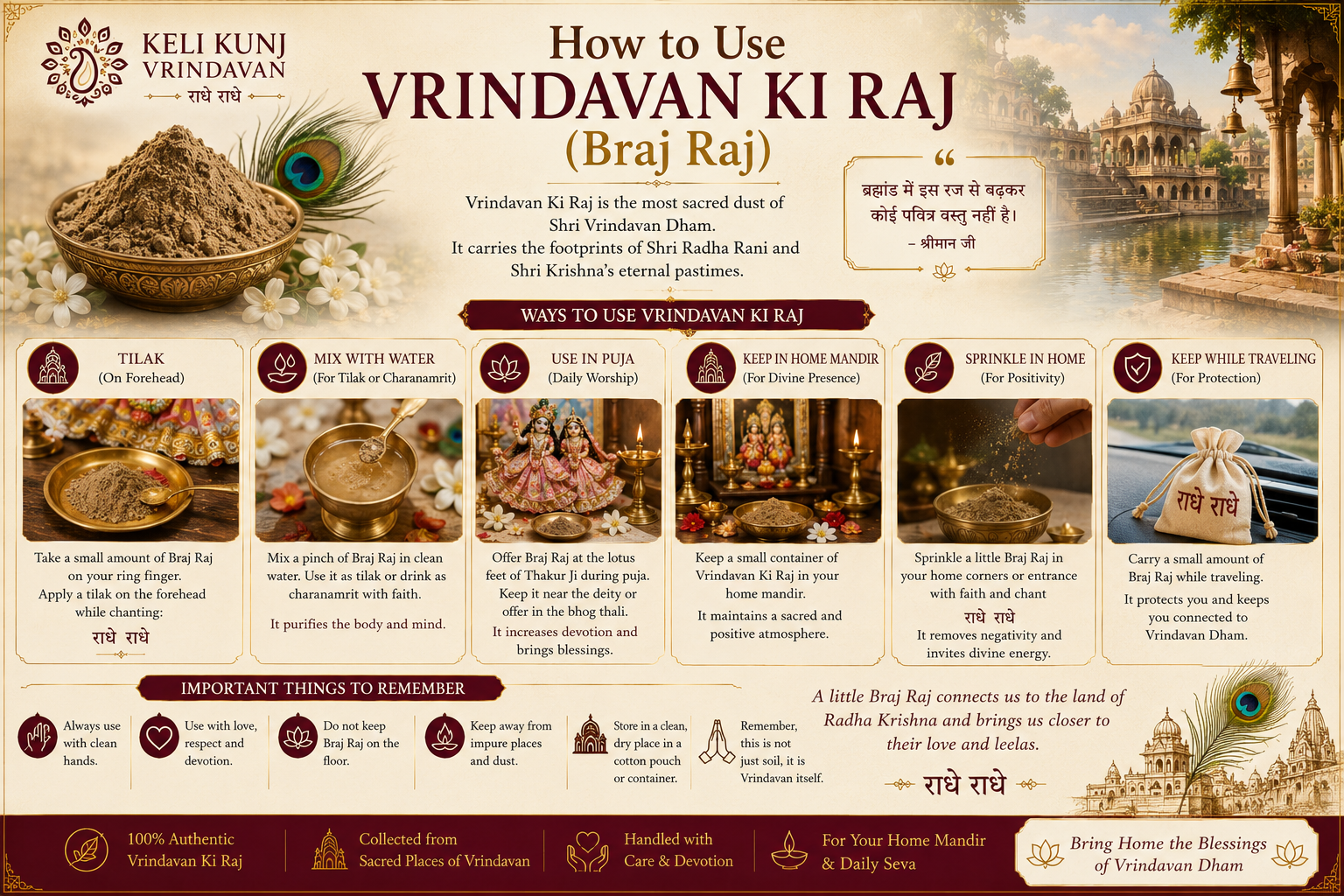
1. As Tilak (Forehead Application)
This is the most common daily use. A small amount of Vrindavan Ki Raj, sometimes mixed with a drop of water to form a light paste, is applied to the forehead as tilak — much like chandan tilak, but carrying the specific significance of Braj’s sacred ground.
How to apply:
- Take a pinch of the raj between your fingers
- If needed, mix with a drop of water or rose water to form a light paste
- Apply gently to the forehead, typically after your morning bath, before starting puja or the day’s activities
Many devotees apply it daily as part of their regular routine, similar to how chandan or kumkum tilak is used.
2. During Puja and Daily Worship
Vrindavan Ki Raj can be kept near your home mandir and used as part of daily puja — a small pinch offered respectfully, or simply kept in a small container on the puja shelf as a sacred presence connecting your home worship to the holy land itself. Some devotees place a small amount directly in front of their Thakur Ji or Radha Krishna murti as a symbolic offering.
3. Consuming a Small Amount (As Some Traditions Practice)
This is a point worth being clear and careful about. Some devotees, following specific traditions, consume an extremely small amount of Vrindavan Ki Raj — typically a few grains, sometimes with water — believing it carries spiritual blessing. If you choose to follow this practice:
- Use only a very small quantity (a few grains, not a spoonful)
- Make sure the raj you’re using is sold specifically as safe for this purpose, sourced cleanly
- If you have any digestive sensitivity or health concern, it’s best to consult your doctor first, or simply use it externally as tilak instead
This isn’t a practice everyone follows, and it’s entirely a personal or lineage-based choice — external application as tilak is the more universally practiced method.
4. Keeping It in Your Home as a Sacred Presence
Beyond active use, many devotees simply keep a small container of Vrindavan Ki Raj in their home mandir or a respected corner of the house — not necessarily using it daily, but keeping it as a reminder of Braj and its sanctity. This is especially meaningful for devotees living far from Vrindavan, in the USA, Australia, Canada, or elsewhere, as a small physical connection to the holy land.
5. During Travel or Difficult Times
Some devotees carry a small amount of Vrindavan Ki Raj with them while traveling, or keep it close during difficult periods, drawing comfort from its association with Radha-Krishna’s protective presence. This is a personal devotional practice rather than a fixed rule — there’s no single “correct” occasion for it.
How to Store It
- Keep it in a clean, dry container — a small brass or glass box works well
- Store it in your puja area or another respected space in the home, away from the kitchen or bathroom
- A small quantity lasts a long time, since only a pinch is used at a time
A Note on Respect
Regardless of exactly how you use it, the underlying spirit is the same: Vrindavan Ki Raj is treated with the same reverence devotees would show the holy land itself. It isn’t handled casually, stepped over, or placed in the same regard as ordinary items — many devotees make a point of washing their hands before touching it and keeping it in a clean, elevated space.
A Note From Vrindavan
At Keli Kunj, our Vrindavan Ki Raj is sourced directly from sacred sites in Braj, including Radha Kund, exactly as devotees have collected and used it for generations. Whether you’re beginning a daily tilak practice or simply want a small piece of Vrindavan close to your home mandir, we hope it carries the same reverence for you that it has for devotees for centuries.
Explore our Vrindavan Ki Raj collection, sourced from the sacred land of Braj.
Radhe Radhe.
Frequently Asked Questions
They refer to the same thing — sacred soil from Vrindavan Dham. “Braj Raj” is simply another common name for it, sometimes used interchangeably, sometimes referring to soil collected specifically from the wider Braj region.
Just a small pinch is enough. It can be applied dry or mixed with a drop of water to form a light paste before applying to the forehead.
Some devotees, following specific traditions, consume a very small amount (a few grains). This is a personal or lineage-based practice rather than a universal rule — if you have any health concerns, it’s best to use it externally as tilak or consult a doctor first.
Keep it in a clean, dry container in your puja area or another respected corner of your home, away from the kitchen or bathroom.
Yes — it’s meant precisely for devotees who may not be near Vrindavan physically. Keeping and using it at home, wherever you live, is considered a meaningful way to stay connected to the holy land.